
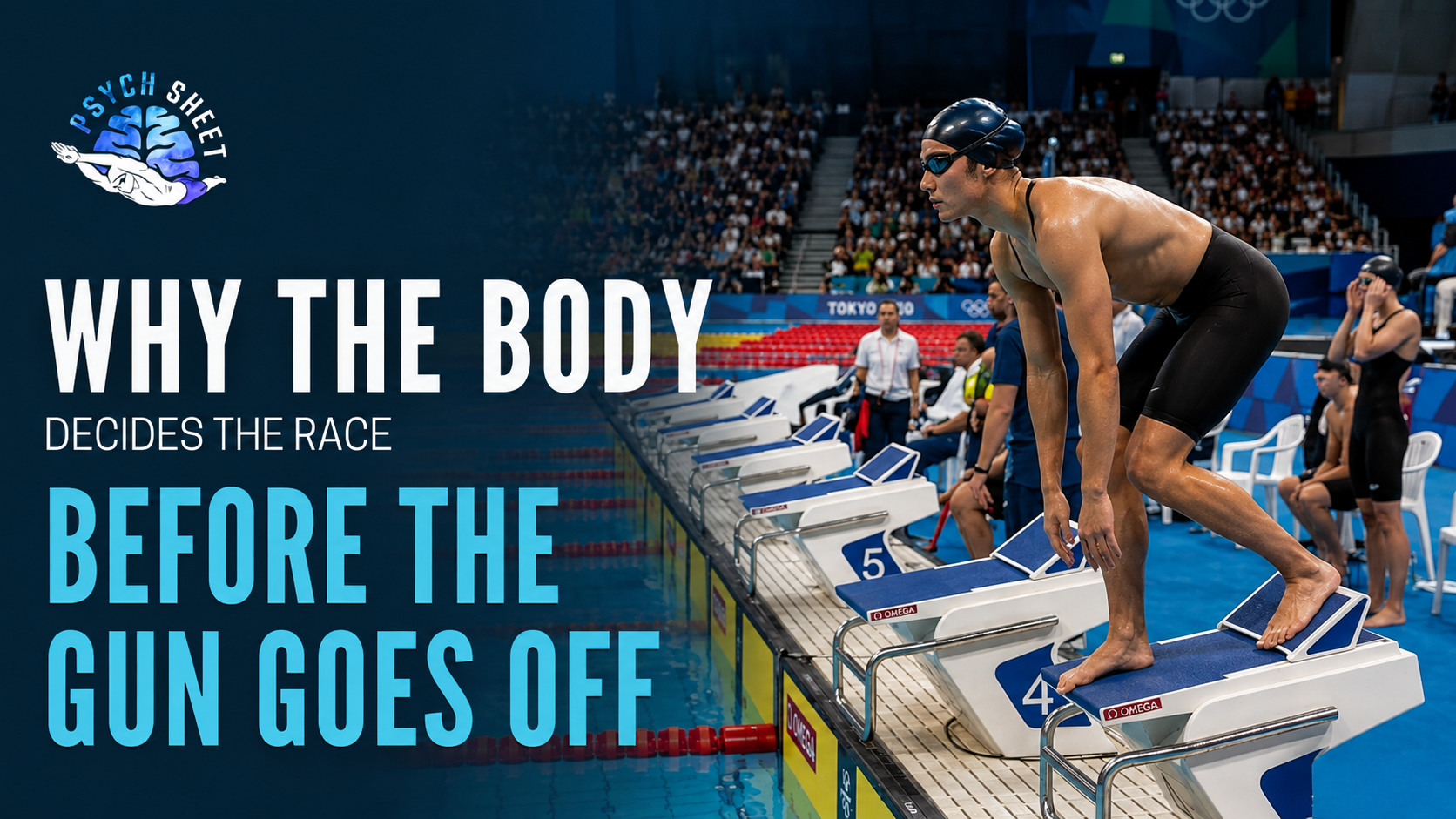
A swimmer stands behind the blocks. His stroke is dialed in. His taper went perfectly. And his hands are shaking, his breathing is shallow, and his mind has gone somewhere far away from the water in front of him.
Nothing about his preparation explains this. What’s happening is his nervous system, and it’s the second component of the Internal Performance System, the mental infrastructure behind the Connor Elite Performance System.
If you’ve ever wondered why a swimmer can look completely composed in practice and fall apart physically before a big race, or searched for help with pre-race anxiety in swimmers, this is the layer underneath it. It isn’t nerves in the casual sense. It’s a physiological system doing exactly what it’s trained to do, just not in the swimmer’s favor. And the good news is that once you understand how it works, it becomes something you can actually help with.
The Nervous System Isn’t “Nerves.” It’s Infrastructure.
When people talk about a swimmer being nervous, they usually mean something vague and emotional. But the nervous system is not a feeling. It’s the body’s automatic threat-detection and regulation system, running continuously, mostly outside conscious control.
Its job is simple: scan the environment, decide whether the current situation is safe or dangerous, and prepare the body accordingly. In a genuine emergency, this system is essential. It’s why humans survive. The problem is that this same system cannot always tell the difference between a real threat and a big meet. A packed pool deck, a seed time on the board, a college coach in the stands: none of these are physically dangerous, but to a nervous system that has learned to associate competition with threat, they can trigger the exact same response as danger.
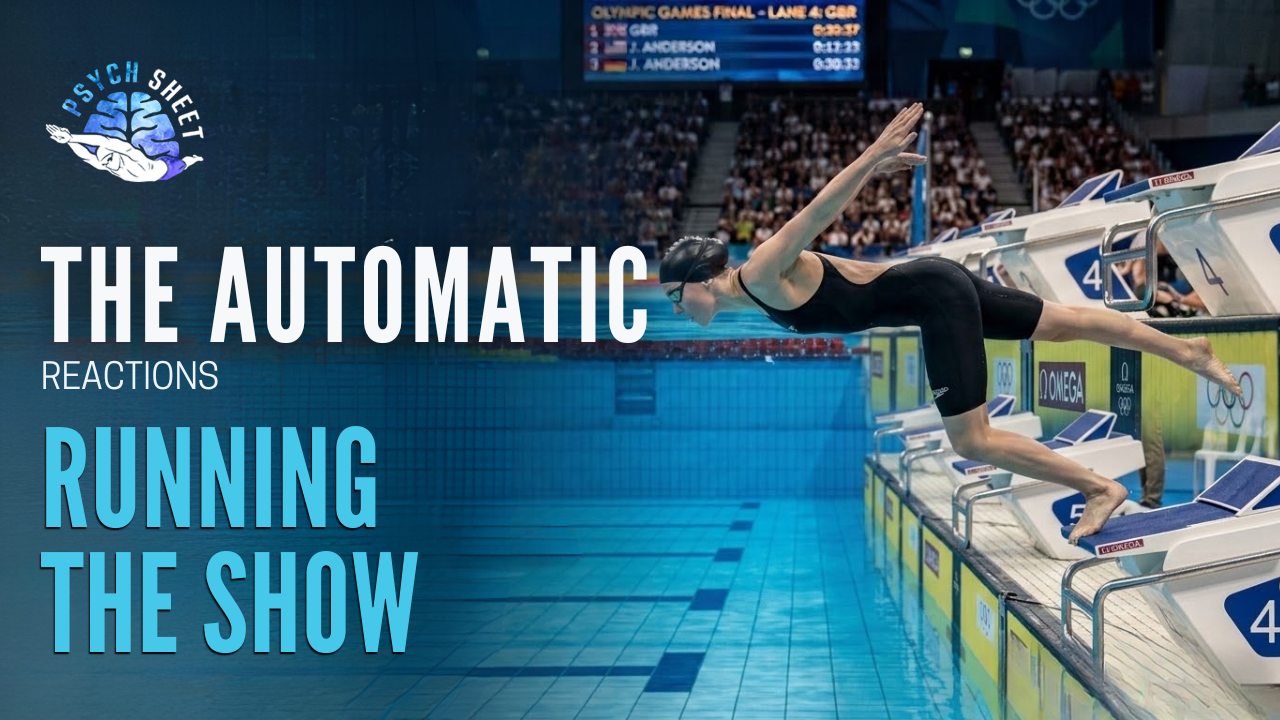
That response is called sympathetic activation, commonly known as fight or flight. Heart rate climbs. Breathing gets shallow and high in the chest. Blood moves away from fine motor control and toward large muscle groups built for running or fighting. This is a poor physiological state for executing a precise, technical skill like a swim stroke, which is exactly why a swimmer’s technique can degrade under competition pressure even though nothing about his physical ability has changed.
Why This Explains the Practice-to-Meet Gap
This is the mechanism behind one of the most common frustrations in the sport: an athlete who trains beautifully and competes inconsistently. In practice, the nervous system generally reads the environment as safe. Familiar pool, familiar coach, low external evaluation. The body stays regulated, and the swimmer’s trained skill shows up cleanly.
At a meet, the same nervous system may read the environment as unsafe, even though the swimmer consciously knows nothing is wrong. Once that shift happens, the body is no longer running on trained motor patterns. It’s running on a stress response, and stress responses were never built for stroke technique. This is also why telling an anxious swimmer to simply calm down rarely works. The nervous system isn’t responding to logic. It’s responding to a learned association, and the reassuring part is that learned associations can be unlearned with the right kind of practice.
Why a Swimmer’s Nervous System Responds to the Adults Around Him
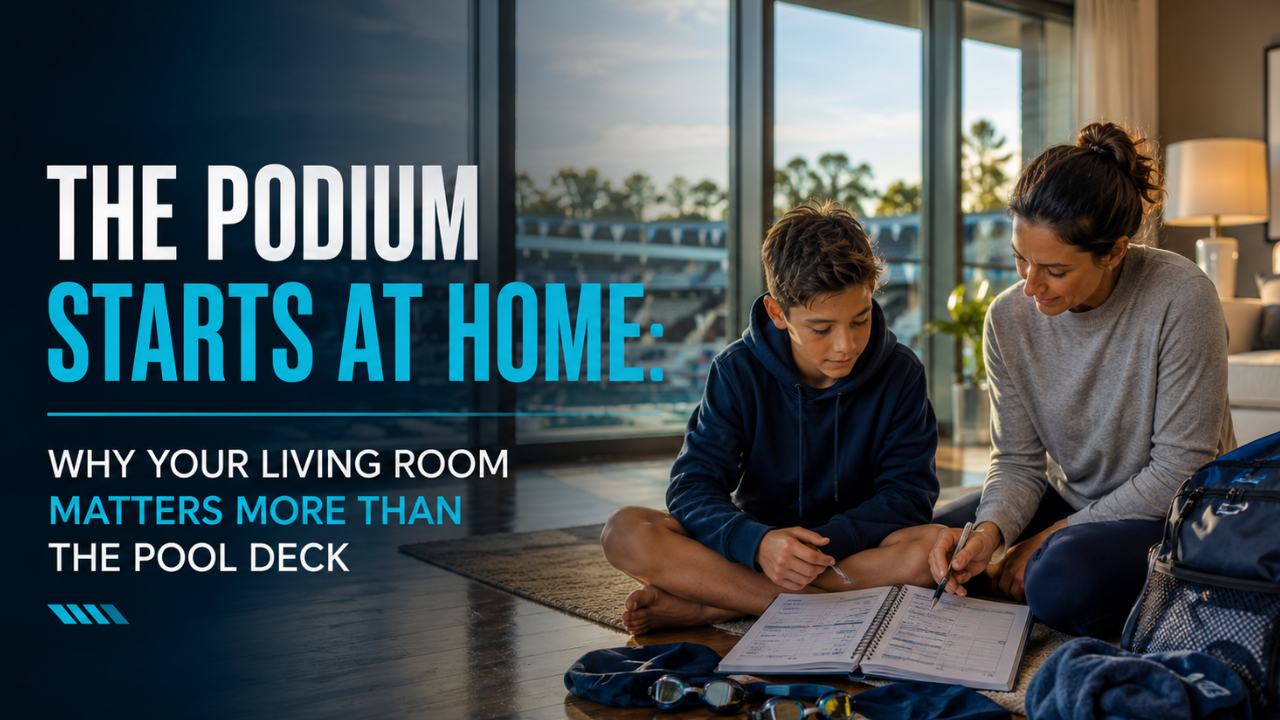
One of the most overlooked facts about the nervous system is that it doesn’t regulate in isolation. Nervous systems are deeply influenced by the nervous systems around them, a process sometimes called co-regulation. A swimmer picks up on a coach’s tension on deck or a parent’s anxiety in the stands well before either says a word, and his own nervous system calibrates accordingly.
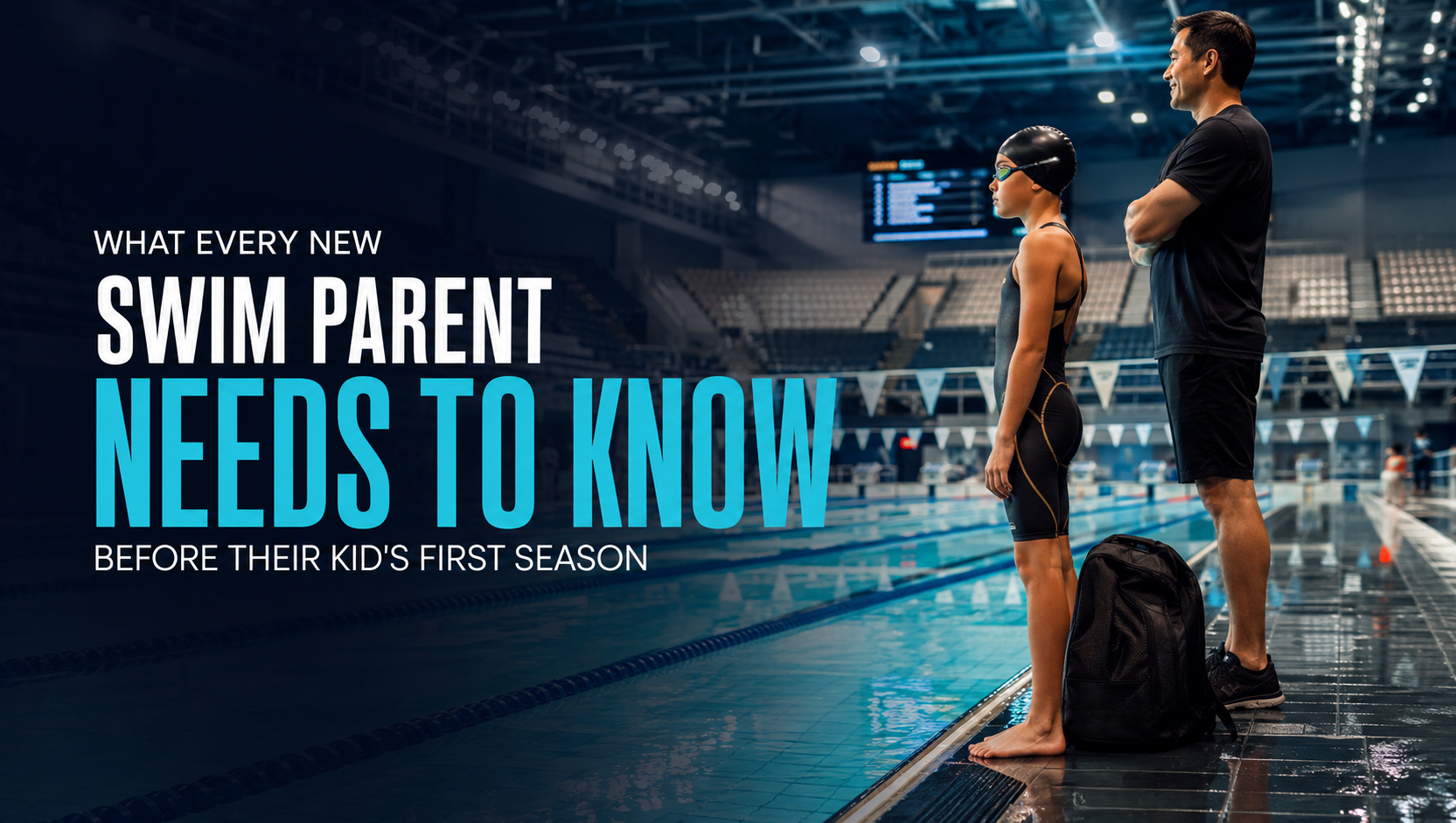
This is why the car ride to a meet matters more than most parents realize. A tense, anxious car ride can prime a swimmer’s nervous system for threat before he’s even stepped on deck. A calm, steady one can do the opposite. None of this is about what’s said. It’s about the physiological state the adults around a swimmer are broadcasting, often without any awareness they’re doing it. This also means every parent already has real influence here, often more than they realize.
This dynamic is also why the same coaching or parenting approach can produce different results with different athletes. A swimmer with a well-regulated nervous system can tolerate a high-intensity, high-pressure environment and even thrive in it. A swimmer whose nervous system is already primed toward threat will often shut down or overcorrect under that same intensity. The environment isn’t the variable. The nervous system receiving it is.
Regulation Is a Trainable Skill, Not a Personality Trait
The encouraging part of all this is that nervous system regulation isn’t fixed. It isn’t a personality trait some swimmers have and others don’t. It’s a skill, and like any skill, it can be built through deliberate practice, which means real, lasting change is available to every swimmer, not just the ones who seem naturally calm.
Regulation training generally focuses on a few areas working together:
Building awareness of the body’s early signals. Most swimmers don’t notice sympathetic activation until it’s already in full effect. Learning to recognize the earliest signs, a shift in breath, a tightening in the chest, gives an athlete a window to intervene before the state takes over.
Developing tools that speak the nervous system’s language. Logic and reassurance rarely reach an activated nervous system. Breath work, physical grounding, and structured pre-race routines do, because they work directly with the physiological system rather than trying to talk it down.
Repeated exposure under manageable pressure. A nervous system that has never practiced staying regulated under pressure has no template for doing so at a championship meet. Gradually training the body to stay regulated in higher-stakes moments builds a felt sense of safety that eventually generalizes to competition.
Over time, this training changes what a swimmer’s nervous system expects from competition itself. Instead of automatically reading a meet as a threat, a well-trained nervous system can learn to read it as familiar, even exciting, rather than dangerous. That shift, from dread to something closer to anticipation, is one of the most rewarding changes a swimmer and the people around him can experience together.
Why This Matters for Everyone Around the Swimmer
For coaches, this reframes what’s happening when a talented athlete seems to fall apart under pressure. It’s rarely a mental toughness issue in the way that phrase usually gets used. It’s a nervous system responding exactly as it’s been trained to respond, and it can be retrained the same way a stroke flaw can be corrected, which means you already have more to offer that swimmer than you might think.
For parents, this is a direct, practical point of influence. A swimmer’s nervous system is listening to the ones around him constantly, in the car, on deck, in the stands. Becoming a steadier presence isn’t a soft or secondary role. It’s one of the most concrete, hopeful ways a parent can shape competitive performance, and it’s something every parent is capable of building.
For club leaders, this points to why a team’s culture, not just its training plan, affects how athletes perform when it counts. An environment that consistently signals safety and steadiness will produce more regulated athletes than one that runs on constant urgency, regardless of how good the technical coaching is.
The nervous system doesn’t lie, and it doesn’t negotiate with logic. It responds to what it has learned to expect. The reassuring truth is that what’s been learned can be relearned, and every swimmer, coach, and parent has a real role to play in making that happen.
Frequently Asked Questions
Why does my swimmer get anxious before meets but not before practice?
The nervous system often reads practice as a safe, familiar environment and competition as a threat, even when there’s no real danger. This triggers a stress response that can interfere with trained motor skills, producing anxiety and physical symptoms that don’t show up in practice.
Can a swimmer’s nervous system actually be trained?
Yes. Nervous system regulation is a skill built through body awareness, tools like breath work and grounding, and gradual exposure to pressure in a controlled way, not a fixed trait a swimmer either has or doesn’t have.
How does a parent’s own anxiety affect a swimmer’s performance?
Through a process called co-regulation, a swimmer’s nervous system picks up on the emotional and physiological state of the adults around him, particularly in the hours before a race. A calmer adult presence can help a swimmer’s nervous system stay regulated heading into competition.
One swim parent put it simply after learning to see her son’s nerves this way: it gave her family a way to talk about competition that finally felt calm instead of stressful. That shift is available to any family willing to look at the nervous system for what it actually is, not a flaw to fix, but a system that can be taught something new.