
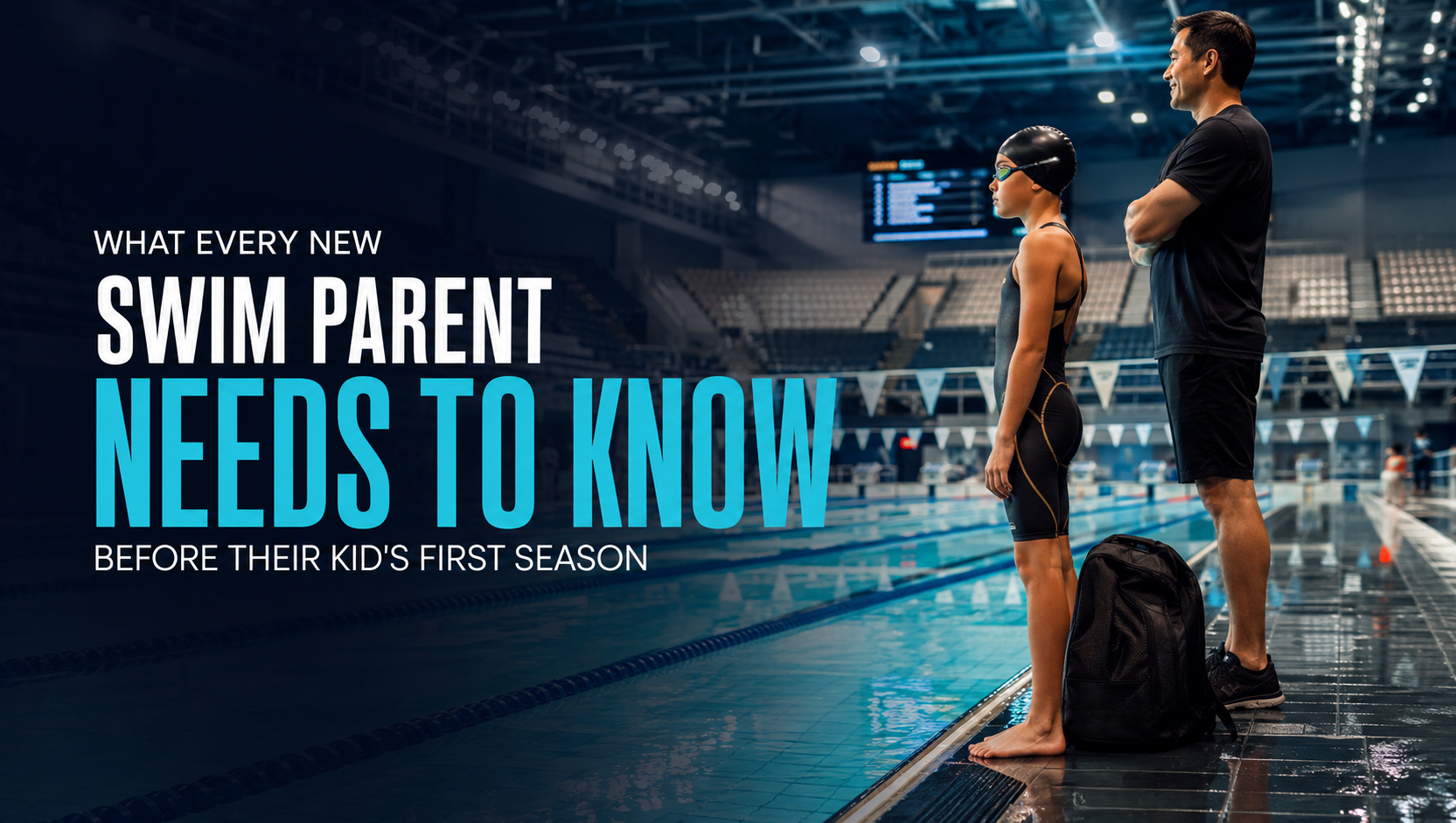
Your child just signed up for their first swim team. Congratulations, and welcome to a sport that’s equal parts chlorine, car pool logistics, and quiet pride watching your kid do something hard. Competitive swimming can feel overwhelming at first glance: heat sheets, seed times, splits, DQs. But most of what trips up new families isn’t complicated. It’s just unfamiliar. Here’s what actually matters as you get started.
1. Practice Is the Whole Point, Not the Warm-Up to the Meet
New parents often treat practice as prep work and meets as the “real” event. Swimmers who thrive tend to flip that thinking. Practice is where technique gets built, where endurance gets banked, and where a kid quietly becomes a stronger swimmer rep by rep. Meets are simply where that work gets to show up.
Try not to ask “did you win?” after every meet. Ask what felt different in the water, or what they noticed about their turns. It shifts the conversation from outcome to growth, which is exactly where a young swimmer’s confidence should live.
2. Attendance and Consistency Beat Talent, Especially Early On
Talent gets attention in the first few weeks. Consistency is what actually builds a swimmer. Kids who show up regularly, even on tired days, improve faster than naturally gifted kids who attend sporadically. If your family is new to the sport, treat practice attendance as non-negotiable in the same way you’d treat school attendance. It sets a tone early that swimming is something your child does, not something they do when convenient.
3. Gear Matters Less Than You Think (At First)
You don’t need the top-tier suit, the fastest goggles, or a mesh bag full of gadgets in month one. A properly fitted swimsuit, two pairs of goggles (because one will inevitably go missing at the worst moment), a mesh bag, a towel, and a water bottle will get most young swimmers through their first season. As they move into more competitive levels, gear conversations get more specific. Early on, simple is fine.
4. Learn the Language, Slowly
You’ll hear terms like IM, DQ, splits, seed time, and negative split thrown around on deck like everyone’s fluent. Nobody is born knowing this vocabulary. Ask a coach or a veteran swim parent to translate when you’re lost. Most swim parents remember being confused their first season and are happy to help. Within a month or two, you’ll be using the terms yourself without thinking twice.
5. Meet Day Nerves Are Normal, and They’re Not Just Your Kid’s
Meets can be long, loud, and unpredictable, especially the first few. Your child may feel nervous standing behind the blocks. You may feel nervous watching from the stands. Both are completely normal. What helps most is keeping your own energy steady. Kids pick up on parental anxiety fast, and a calm parent on the pool deck is one of the most stabilizing things a young swimmer can have.
Resist the urge to over-coach from the stands. Let the coaches coach. Your job is to be present, encouraging, and low-drama, win or lose.
6. Your Involvement Shapes Their Relationship With the Sport
How you talk about swimming at home has a bigger impact than most parents realize. Kids who feel pressure to perform for their parents’ approval often burn out faster than kids who feel supported regardless of the clock. The goal isn’t to lower expectations. It’s to separate your child’s worth from their times.
This is where identity, not just skill, starts to matter. A swimmer who sees themselves as “someone who works hard and keeps improving” tends to handle a bad meet very differently than a swimmer who only sees themselves as “fast” or “not fast.” That distinction shapes how kids respond to setbacks for years, not just this season.
This is exactly the idea behind Michael E. Connor’s book, The Swimmer You’re Becoming, written for swimmers ages 8 to 12 and the parents raising them. The book introduces identity-based thinking in age-appropriate language, helping young swimmers understand that who they’re becoming in the water matters more than any single race. It’s designed to grow with your swimmer, so the same foundation still applies as they move into higher level club competition and eventually high school and state-level meets. For new swim parents looking for a way to talk about mindset and confidence without turning every conversation into a lecture, it’s a useful starting point.
7. Not Every Practice or Meet Will Go Well, and That’s Fine
There will be off days. Missed walls, slow splits, a meltdown in the car on the way home. This is part of a normal season, not a sign something’s wrong. Long-term swimmers, and long-term swim parents, learn to treat a bad day as information rather than a verdict. What matters is how the season trends over months, not how any single Tuesday practice or Saturday meet goes.
8. Find Your Swim Team Community
Swim team can absorb a lot of family time between practices, meets, and volunteer shifts. It helps enormously to build relationships with other swim parents early. They’ll become your carpool network, your source of “wait, what does that mean” answers, and often genuine friends. Most swim communities are welcoming to new families, so don’t hesitate to introduce yourself on deck.
Signing your child up for swim team is the easy part. What comes next, the early mornings, the meet-day nerves, the slow build of skill and confidence, is where the real experience lives. Stay consistent, keep your own energy steady, and remember that the swimmer your child is becoming matters more than any single time on the clock.
If you’re looking for a resource to help your young swimmer build that foundation early, The Swimmer You’re Becoming is written specifically for this age group and stage of the journey.