
A swimmer drops two seconds in practice on Tuesday. On Saturday, at the meet, she adds three. Same body. Same training. Same stroke she’s rehearsed a thousand times. So what changed?
Not her fitness. Not her technique. Something underneath both of those things changed the moment the heat sheet went up.
That something is identity, and it’s the first and most foundational component of what we call the Internal Performance System, the mental infrastructure behind the Connor Elite Performance System.
If you’ve ever searched for why swimmers underperform at meets, or looked into sports psychology for competitive swimmers, this is the piece most programs skip. It’s also the piece that determines whether everything else you’re doing, the yardage, the technique work, the taper, actually shows up when the meet starts.
Identity Is Not Confidence, and It’s Not Personality
Most people hear “identity” and think of something soft. A mindset. A vibe. Maybe confidence, maybe personality. It’s none of those things.
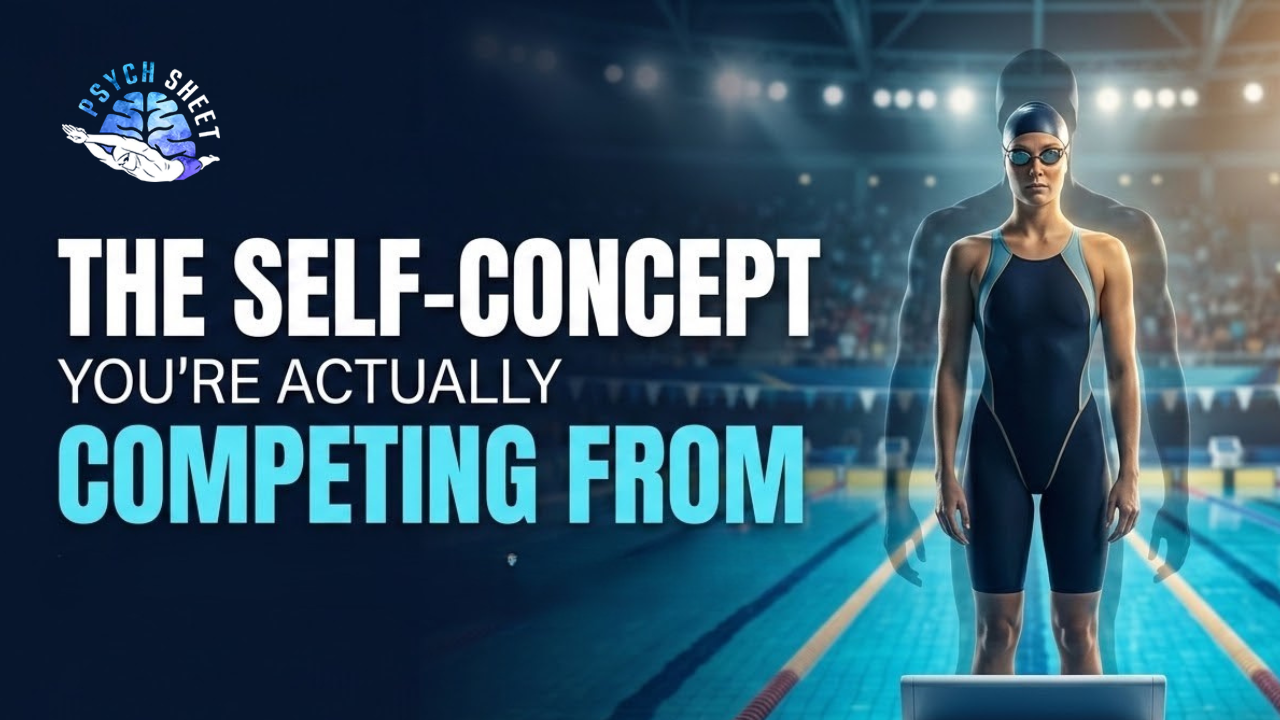
Identity, in the performance sense, is the self-concept an athlete is competing from in a given moment. It’s the internal answer to the question who am I right now, under these conditions and that answer is generating a physiological state in real time. Heart rate. Muscle tension. Breath. Focus. The nervous system doesn’t respond to what a swimmer knows how to do. It responds to who the swimmer believes she is while she’s doing it.
This is why an athlete can be flawless in practice and inconsistent in competition. Practice and competition often call up two different identities. One is relaxed, familiar, low-stakes. The other is watched, evaluated, high-stakes. If the swimmer hasn’t built a stable identity that holds under both conditions, the body will perform two different ways, even though nothing about her physical preparation has changed.
This distinction matters because it changes where you look for the fix. A technique problem gets solved on deck. An identity problem does not.
Why Every Other Component of Mental Performance Depends on This One
The Internal Performance System has six components: Identity, Nervous System, Attention, Patterns, Mental Rehearsal, and Energy. Every one of them is downstream of identity.
An athlete’s nervous system responds to the identity it believes it needs to protect. Attention goes wherever that identity feels most threatened. Patterns, the habitual reactions that show up under pressure, are simply identity playing itself out automatically, without the athlete consciously choosing them. Even mental rehearsal only works if the identity being rehearsed is one the athlete actually believes is true.
Skip identity, and the other five components are just techniques applied to an unstable foundation. That’s the piece most training programs, even good ones, never touch. Most competitive swimming mental training focuses on symptoms: breathing exercises for race-day nerves, visualization scripts, motivational talks before finals. These aren’t wrong. They’re just incomplete, because they’re built on top of a self-concept nobody addressed.
Why This Gets Misdiagnosed So Often
Here’s what makes identity hard to catch: it isn’t visible from the outside. A coach can watch a stroke and diagnose a mechanical flaw in seconds. Nobody can watch a warm-up and see which identity an athlete is competing from. It only shows up indirectly, in the gap between what a swimmer produces in practice and what she produces when it counts.
That gap gets misread constantly. It gets called a focus problem. A nerves problem. A mental toughness problem. Coaches add more mental toughness talk. Parents add more encouragement, or more pressure, hoping one of the two will land. Neither one addresses what’s actually happening, because neither one is built on the level where the problem lives.
This is also why generic sports psychology advice often falls flat for competitive swimmers specifically. Swimming is unique among sports in how isolating the competitive moment is. There’s no teammate to pass the ball to, no crowd noise to hide in, no timeout to regroup. It’s a swimmer alone on a block with several minutes to sit inside whatever identity she’s carrying that day. That environment makes identity instability more visible, and more costly, than in almost any other sport.
How Identity Actually Gets Trained
Identity can be trained the same way a stroke can be trained. Not through pep talks or willpower, but through a structured framework that builds a stable self-concept a swimmer can compete from under any condition, not just the comfortable ones.
That process generally involves three things working together:
Naming the current identity. Most swimmers have never been asked who they believe they are under pressure. Surfacing that belief, often for the first time, is the starting point.
Rebuilding the self-concept deliberately. This isn’t affirmations. It’s a structured process for constructing an identity that holds up under evaluation, not one that collapses the moment the stakes rise.
Reinforcing it until it’s automatic. A new identity that only shows up when a swimmer is thinking about it isn’t stable yet. The work continues until the identity is the default, not the exception.
This is the foundation the Connor Elite Performance System is built on, and it’s why the framework starts here rather than with technique, race strategy, or motivation.
What This Means for Coaches, Parents, and Club Leaders
If you’re a coach, this is likely the piece your program is missing, not because you haven’t tried, but because most sport psychology addresses symptoms: anxiety, focus, confidence, without ever reaching the identity generating all three. A team-wide mental performance curriculum that starts with identity gives you a system you can implement without hiring a sport psychologist.
If you’re a parent, this reframes what your role actually is. A swimmer’s nervous system takes cues from the adults around her, which means the identity she’s competing from is being shaped long before she ever steps on the blocks, often in the car on the way to the meet. Understanding identity gives you language for what’s happening and a way to support it instead of accidentally reinforcing instability.
If you lead a club, this is the difference between athletes whose training shows up on race day and athletes whose training stays in the pool. A club-wide approach to identity development is one of the few investments that scales across an entire roster, not just your top swimmers.
The Gap Isn’t Physical. It Starts Here.
The gap between how a swimmer trains and how she competes isn’t physical. It starts with identity, and it’s the first place the Internal Performance System begins the work.
If you’ve been chasing this gap through more yardage, more technique drills, or more pep talks without seeing it close, identity is likely the missing layer. It’s not a mindset trick. It’s trainable infrastructure, the same way a stroke or a start is trainable, and it’s the foundation everything else in competitive performance is built on.
Frequently Asked Questions
What is the Internal Performance System?
The Internal Performance System is the mental framework behind the Connor Elite Performance System. It’s made up of six components: Identity, Nervous System, Attention, Patterns, Mental Rehearsal, and Energy, all of which govern whether physical training shows up in competition.
Why do some swimmers perform worse at meets than in practice?
This gap is usually not physical. It’s typically driven by an unstable competitive identity, meaning the swimmer’s self-concept under pressure differs from her self-concept in low-stakes practice, producing a different physiological and mental state on race day.
Can identity actually be trained like a physical skill?
Yes. Identity is not fixed personality. It can be named, rebuilt, and reinforced through a structured framework until a stable, competition-ready self-concept becomes the swimmer’s default state, not just an occasional one.
If this gap sounds familiar, start with In The Zone, our free guide to building focus, resilience, and a stable competitive identity. Download it free →